

Gas plumbing in Thornton, CO requires specialized skills due to the area's unique environmental challenges and diverse housing stock. They provide essential services including leak detection, appliance calibration, and emergency repairs to ensure safety and efficiency.
- Gas plumbing involves critical tasks like appliance connections and leak detection, which require specialized training. Thornton's high altitude affects gas appliance performance, necessitating precise calibration.
- Older homes may have outdated piping that needs careful inspection, while newer constructions might require additional gas capacity for modern appliances.
- The company offers 24/7 emergency response and direct communication with technicians, ensuring prompt and effective service for gas-related issues.
A gas plumber specializes in installing, repairing, and maintaining gas lines and appliances, ensuring safety and compliance with regulations. They possess the necessary licensing and diagnostic skills to address issues like gas leaks or malfunctioning pilot lights, which require immediate attention to prevent hazards.
Gas Plumber Services in Thornton, CO
That faint smell of sulfur near your water heater or the pilot light that refuses to stay lit – these moments demand immediate attention from a qualified gas plumber. Gas line work sits at the intersection of plumbing expertise and safety-critical infrastructure, requiring specialized licensing and precise diagnostic skills that general plumbers simply don't possess.
Gas plumbing encompasses everything from appliance connections and line installations to leak detection and emergency repairs. In Thornton's high-altitude environment – sitting at roughly 5,350 feet above sea level – gas appliances require specific calibration to burn fuel efficiently. The thin mountain air affects combustion ratios, and improperly adjusted equipment can produce dangerous carbon monoxide levels or waste significant amounts of fuel.
- Professional leak detection using electronic sniffers and pressure testing equipment
- Proper high-altitude appliance calibration for furnaces, water heaters, and ranges
- Code-compliant installations that pass inspection the first time
- Emergency response for suspected gas leaks and equipment failures
Thornton's housing stock ranges from 1950s ranch homes with original galvanized steel gas lines to brand-new construction in developments like Crossing Pointe. This diversity means gas plumbing challenges vary dramatically from one neighborhood to the next. Older corrugated stainless steel tubing – once considered state-of-the-art – now requires careful inspection for potential failure points, while newer homes may need additional gas capacity as homeowners add outdoor kitchens or backup generators.
Common Gas Plumbing Issues in Thornton, CO
Cardom Plumbing & Heating provides Gas Plumber services in all neighborhoods of Thornton including Amber Creek, Burgundy, Eastlake, Fox Run, Holiday Hills Village, Lambertson Lakes, Loma Linda Estates, Marshall Lake, North Hills, Original Thornton, Pine Lakes Ranch, Quebec Highlands, The Grove at Alta Ridge, Wind Dance, Woodland Hills, and York Highlands.
Thornton's semi-arid climate creates unique stressors on gas infrastructure that homeowners in more temperate regions rarely encounter. The dramatic temperature swings – sometimes 40 degrees or more in a single day – cause metal gas lines to expand and contract repeatedly. Over years, this thermal cycling weakens fittings and can create microscopic leaks at connection points.
The clay-heavy soils prevalent throughout Adams County add another complication. These expansive soils shift seasonally as moisture levels change, placing lateral pressure on underground gas lines running from the meter to the home. Homes built in the 1970s and 1980s often used black iron pipe for these runs, and decades of soil movement can stress threaded connections to the point of failure.
Local Factors Affecting Gas Systems
- Altitude effects – Reduced oxygen density requires specific orifice sizing and regulator adjustments for all gas appliances
- Freeze-thaw cycles – Thornton averages 157 days per year with temperatures below freezing, stressing outdoor gas equipment and meter connections
- Dry winter air – Low humidity accelerates corrosion on exposed gas fittings and can dry out flexible connector gaskets
- Soil composition – Bentonite clay soils expand up to 15% when saturated, shifting underground lines
- Housing age diversity – Neighborhoods like Eastlake contain homes spanning five decades, each with different gas piping materials and installation standards
- Municipal infrastructure – Xcel Energy's distribution network serves the entire city, but pressure variations occur in older service areas
Warning Signs Requiring Professional Attention
Gas leaks don't always announce themselves with obvious odors. Watch for these indicators that suggest your gas system needs inspection:
- Dead vegetation in a line pattern across your yard
- Hissing or whistling sounds near gas appliances or the meter
- Higher-than-expected gas bills without increased usage
- Yellow or orange furnace flames instead of steady blue
- Soot accumulation around appliance burners
- Condensation on windows near gas appliances – indicating incomplete combustion
Recent Work
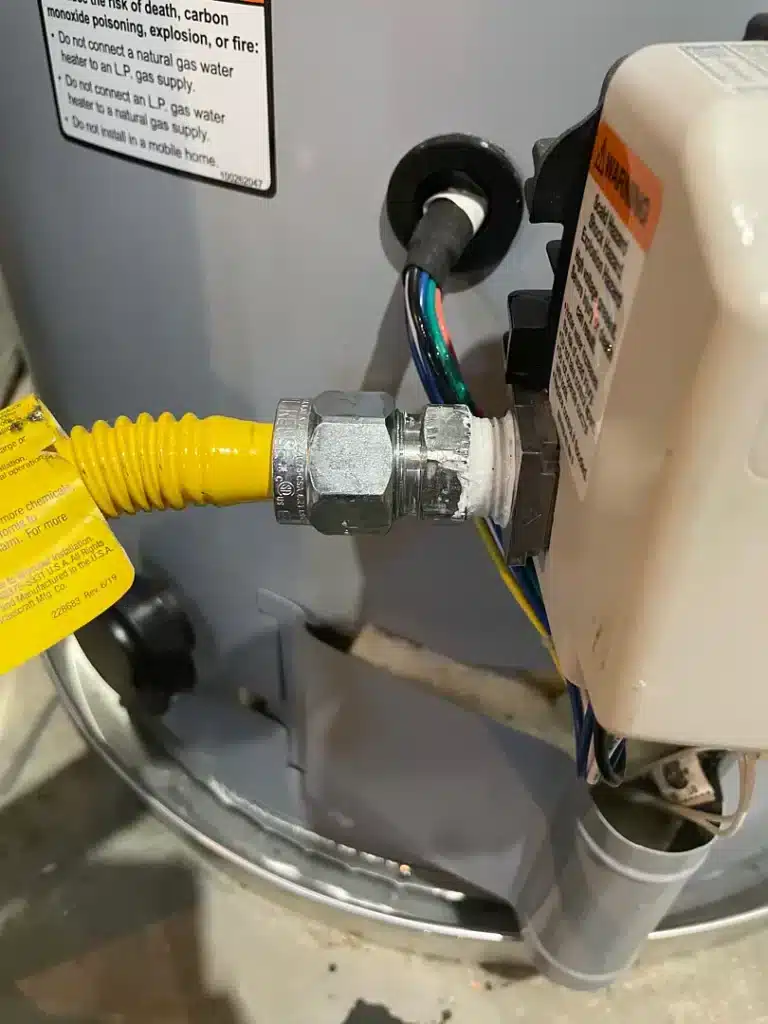
Repair Gas Leak at Water Heater - Thornton
- Problem: Find and repair gas leak at water heater.
- Found: Found small leak on gas flex connector.
- Fixed: Turned off gas and disconnected i/2 union fitting. Applied pipe dope and tightened fitting. Turned on gas and tested all joints
- Outcome: Tested and no leak.
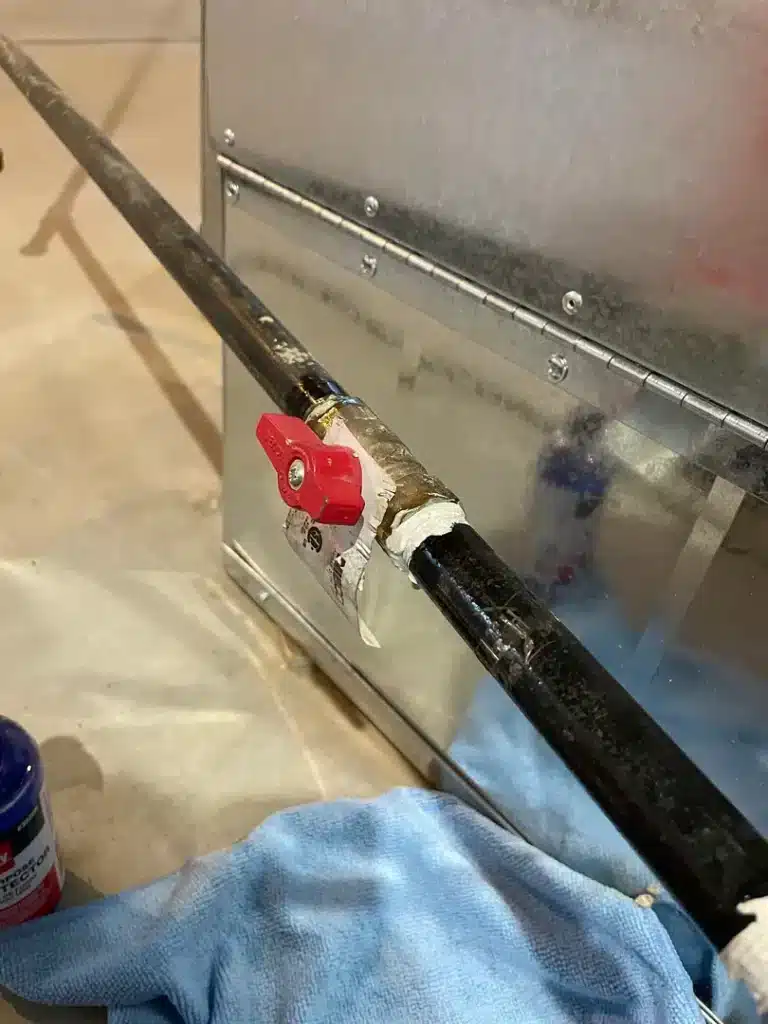
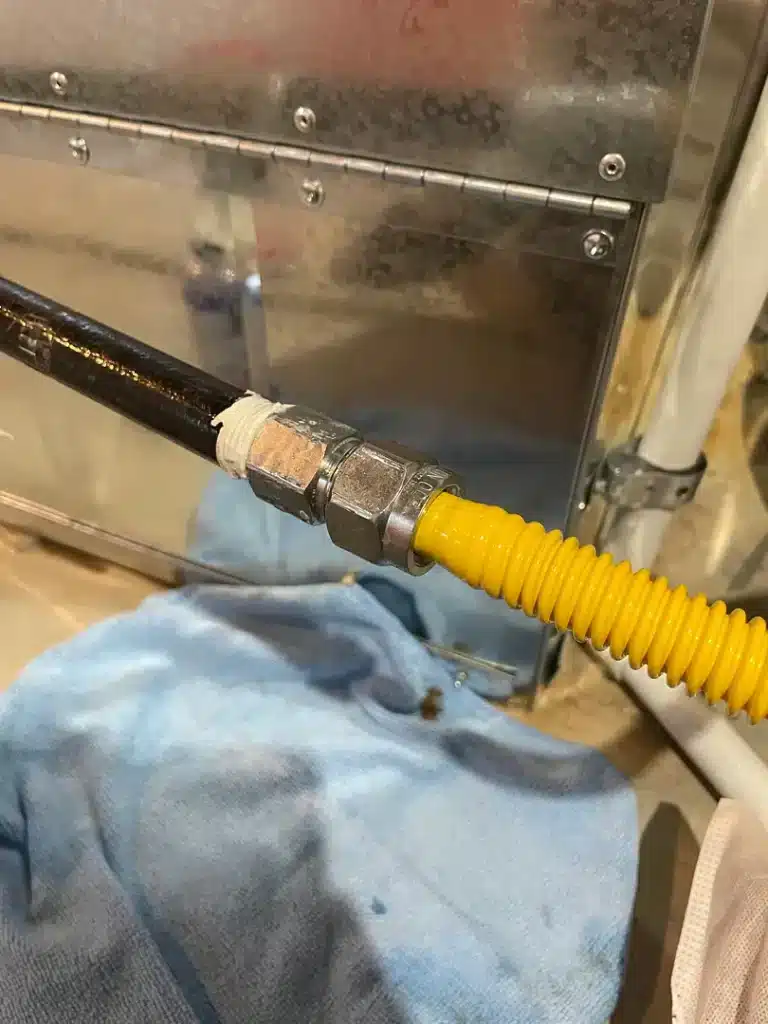
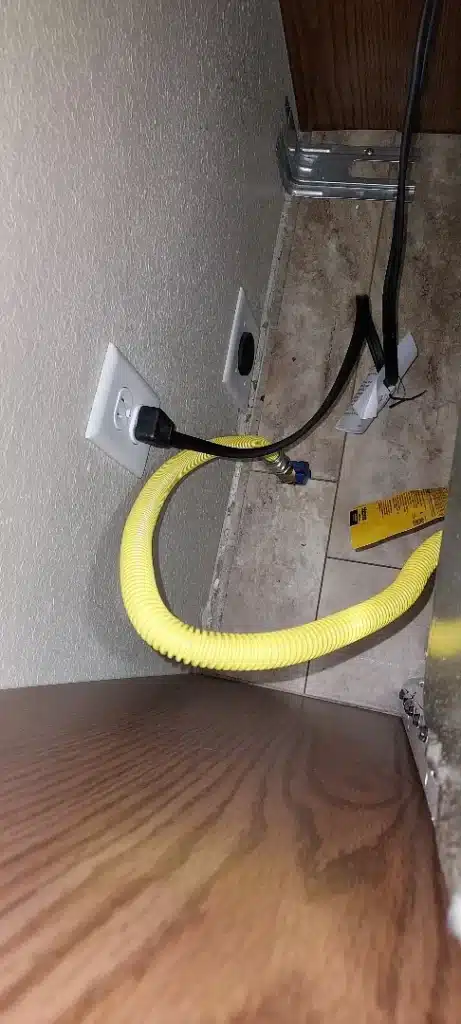
Hook up gas to new stove - Thornton
- Problem: Gas to new stove.
- Found: Replaced existing gas cock.
- Fixed: Replace gas valve with new. Installed. Installed flexible gas supply provided by Arvada Appliance.
- Outcome: Tested for function and gas leaks.

How Cardom Plumbing & Heating Can Help
Gas line work follows strict protocols that protect both your family and our technicians. Every service call begins with systematic safety checks before any diagnostic or repair work commences.
Our Gas Plumbing Process
- Initial safety assessment – We check for active leaks using combustible gas detectors, verify ventilation, and confirm appliance shutoff valve accessibility
- System documentation – Mapping existing gas lines, identifying pipe materials, and noting appliance BTU loads helps us understand your complete system
- Pressure testing – We isolate sections of your gas piping and conduct pressure drop tests to identify even small leaks invisible to electronic sniffers
- Diagnostic findings review – Before any work begins, we explain what we found, what repairs are necessary, and what options exist
- Repair or installation work – Licensed technicians complete all work to current Colorado mechanical code standards
- Final pressure verification – Post-repair testing confirms system integrity under operating conditions
- Appliance functionality check – We verify all connected equipment operates correctly after any line work
Methods and Techniques
Modern gas plumbing relies on precision tools and proven techniques:
- Electronic leak detection – Semiconductor sensors detect gas concentrations as low as 50 parts per million
- Manometer testing – Digital pressure gauges measure system integrity to fractions of an inch of water column
- Pipe inspection cameras – Fiber optic scopes examine interior pipe conditions without excavation
- Tracer gas methods – For difficult-to-locate underground leaks, we use safe tracer gases that rise to the surface
Communication remains central to our approach. You'll receive updates at each phase of the work, and we document everything with photographs for your records. Before leaving, we walk you through any new equipment operation and answer questions about ongoing maintenance.
Why Choose Cardom Plumbing & Heating
Gas plumbing requires credentials that go beyond standard plumbing licenses. Our technicians hold Colorado gas fitter certifications and maintain current training on high-altitude combustion equipment. We carry the specific insurance coverage required for gas line work – something many general plumbing companies lack.
Thornton residents benefit from our local presence and familiarity with area-specific challenges. We know which neighborhoods have problematic soil conditions, which developments used particular piping materials during construction, and which appliance brands perform best at our altitude. This knowledge translates into faster diagnostics and more accurate repair recommendations.
What Sets Us Apart
- 24/7 emergency response – Gas leaks don't wait for business hours, and neither do we
- Direct communication – You'll speak with technicians, not call center representatives
- Permit coordination – We handle Adams County permit applications and schedule required inspections
- Manufacturer relationships – Direct access to technical support for major appliance brands
- Follow-up protocols – Post-repair check-ins confirm your system continues operating correctly
Our diagnostic equipment represents current industry standards – not outdated tools passed down through decades. Digital manifolds, thermal imaging cameras, and combustion analyzers allow us to identify problems that older testing methods miss entirely. This technology investment means fewer callbacks and more accurate first-visit diagnoses.
Housing Characteristics & Gas Plumber Considerations
Thornton's residential landscape reflects six decades of continuous growth, creating a patchwork of gas infrastructure challenges. The original Thornton neighborhoods – developed in the late 1950s and 1960s – feature predominantly single-story ranch homes with basement utility rooms. These properties typically have black iron gas piping throughout, with original connections that have now endured over 60 years of service.
Housing Era Breakdown
- 1950s-1970s construction – Black iron pipe, cast iron drain connections, often undersized gas lines for modern appliance loads
- 1980s-1990s developments – Corrugated stainless steel tubing (CSST) became common, requiring bonding verification and lightning protection assessment
- 2000s-2010s homes – Improved CSST systems with arc-resistant jackets, but installation quality varies significantly between builders
- 2015-present construction – Current code-compliant installations, though rapid construction pace sometimes resulted in inspection oversights
Neighborhoods like Todd Creek and Hunters Glen feature larger homes with multiple gas appliances – furnaces, water heaters, fireplaces, outdoor grills, and sometimes pool heaters. These high-demand systems require properly sized gas lines and adequate meter capacity. We frequently encounter situations where homeowners added appliances without verifying their existing infrastructure could handle the additional load.
Common Housing-Related Gas Issues
Basement renovations present particular challenges in older Thornton homes. Original builders often ran gas lines along ceiling joists or through utility chases that later became finished living space. Accessing these lines for inspection or repair sometimes requires selective demolition, and we work carefully to minimize disruption while maintaining safe access for future maintenance.
- Finished basements concealing gas line access points
- Insufficient clearance around water heaters and furnaces after renovations
- Unpermitted gas fireplace installations lacking proper venting
- Outdoor kitchen connections without required shutoff valves
Environmental Conditions & Gas Plumber Implications
Thornton's position along the Front Range creates environmental conditions that directly impact gas system performance and longevity. The city receives approximately 15 inches of precipitation annually – significantly less than the national average – but this moisture arrives in concentrated bursts that saturate clay soils rapidly before long dry periods cause dramatic shrinkage.
Water Quality and Soil Characteristics
The City of Thornton draws water from multiple sources, including the South Platte River and various reservoir systems. While water quality doesn't directly affect gas lines, the mineral content – particularly calcium and magnesium – contributes to scale buildup in water heaters that share gas supply lines with other appliances. When water heaters work harder due to scale accumulation, they consume more gas and stress the supply infrastructure.
Thornton's soils present significant challenges for underground gas infrastructure:
- Expansive clay content – Soil testing throughout Adams County reveals clay content exceeding 40% in many areas
- Seasonal movement – Ground shifts of 1-2 inches between wet and dry seasons stress buried pipe connections
- Corrosion potential – Alkaline soil chemistry accelerates deterioration of unprotected metal pipes
- Drainage patterns – Poor natural drainage concentrates moisture around foundation walls where gas lines enter homes
Climate Impacts on Gas Systems
Thornton's climate demands gas systems that perform reliably across extreme conditions. Winter temperatures regularly drop below zero, while summer readings exceed 95 degrees. This 100-degree annual temperature range affects every component of your gas infrastructure.
- Regulator performance – Outdoor gas regulators can freeze in extreme cold, reducing flow to appliances
- Thermal expansion – Metal pipes expand and contract with temperature changes, stressing joints and fittings
- Condensation – High-efficiency furnaces produce acidic condensate that must drain properly to prevent equipment damage
- Altitude adjustments – All combustion equipment requires specific calibration for 5,350-foot elevation operation
The Front Range's notorious wind events – including downslope Chinook winds exceeding 80 mph – can damage exterior gas equipment and vent terminations. Post-windstorm inspections frequently reveal shifted vent caps, damaged regulators, and debris accumulation around outdoor appliances.
Natural Gas Infrastructure and Safety Statistics in Thornton
Xcel Energy serves as the primary natural gas provider throughout Thornton and the greater Denver metropolitan area. The utility maintains over 22,000 miles of gas distribution lines across Colorado, with significant infrastructure concentrated in Adams County's rapidly growing communities. Thornton's position as one of Colorado's fastest-growing cities means continuous infrastructure expansion alongside aging original systems.
Colorado's gas safety record underscores the importance of professional gas plumbing services:
- The Colorado Public Utilities Commission recorded over 340 reported gas incidents statewide in recent years
- Excavation damage remains the leading cause of gas line incidents – particularly relevant during Thornton's ongoing construction boom
- Indoor gas leaks account for approximately 15% of fire department hazmat responses in Adams County
- Carbon monoxide incidents spike during October through December as heating systems activate after summer dormancy
Local Infrastructure Considerations
Thornton's rapid growth creates unique infrastructure challenges. New developments in the northern reaches of the city connect to recently installed distribution mains, while established neighborhoods rely on infrastructure dating to the 1960s and 1970s. Pressure variations between these systems affect appliance performance and require different diagnostic approaches.
The 811 "Call Before You Dig" system logs thousands of locate requests annually in Thornton alone, reflecting the density of underground utilities. For gas plumbers, this data highlights the complexity of working around existing infrastructure during line repairs or new installations. Every excavation project requires careful coordination with multiple utility providers to prevent dangerous cross-utility incidents.
- Service line responsibility – Homeowners own gas piping from the meter to appliances; utility responsibility ends at the meter
- Permit requirements – Adams County requires permits for all gas line modifications exceeding simple appliance connections
- Inspection protocols – New installations require pressure testing witnessed by county inspectors before activation
- Emergency response – Thornton Fire Department coordinates with Xcel Energy on all reported gas emergencies
Understanding this infrastructure landscape helps Cardom Plumbing & Heating navigate the regulatory requirements and safety protocols that protect Thornton residents. Our familiarity with local permitting processes and inspector expectations streamlines project completion while maintaining full code compliance.


